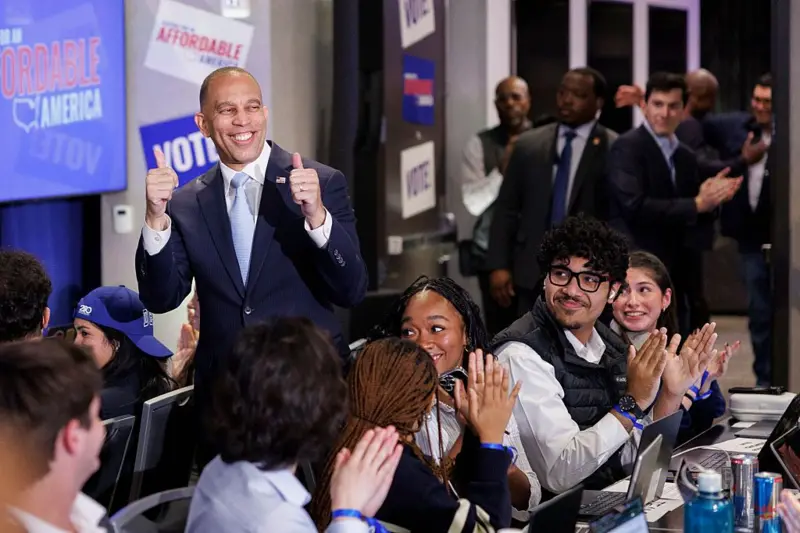
For the Democratic Party, election night felt like a surreal dream. But come January, reality will set in.
They certainly had reason to celebrate on Tuesday night. Thanks to an overwhelming victory, the Democrats will control both chambers of Congress next year.
Hakeem Jeffries, the Democratic leader in the U.S. House of Representatives, declared with excitement: “Today, the great American revival officially begins.”
During the campaign, the Democrats pledged to investigate corruption, lower the costs of healthcare, groceries, and gasoline, and curb the expansion of war with Iran. Now, they face the much harder task of turning those promises into action.
However, the shift in the power landscape in Washington does not mean that the Democratic Party can immediately accomplish everything on its legislative wish list. Although the Democrats control Congress, Republican President Donald Trump still holds the power to veto legislation.
In an interview with the BBC, U.S. Senator Chris Coons warned that the Democratic Party should not view these results as a “mandate,” noting that the party remains “deeply unpopular.”
What can the Democrats do?
Representative Robert Garcia of California is set to lead a powerful oversight committee in the House of Representatives—a panel that could make the final two years of Donald Trump’s term quite difficult.
As election results continued to come in, Garcia issued a statement: “Better get a lawyer.”
Committees in both the U.S. Senate and the House of Representatives possess investigative powers, which can be used to probe the president and his associates regarding issues such as potential conflicts of interest.
On Tuesday, Garcia outlined a long list of potential targets for investigation, including the Trump family, “corporate corruption,” alleged abuses of power within the Department of Homeland Security and U.S. Immigration and Customs Enforcement (ICE), and the government’s handling of the Epstein files.
The Senate also holds the authority to confirm or block the president’s cabinet and judicial nominees.
For instance, should a vacancy arise on the U.S. Supreme Court during a Trump presidency, a Democratic-controlled Senate could block any nomination—or compel Trump to select a more moderate candidate capable of garnering bipartisan support.
The House of Representatives also holds the power to impeach the president—the first step in the congressional process for removing a public official from office.
During Donald Trump’s first term, Democrats initiated impeachment proceedings twice, but the Senate ultimately acquitted him on both occasions.
However, because a conviction in the Senate requires a two-thirds majority—or 67 votes—it remains virtually impossible to remove a president through this process, even if the Democrats were to regain control of Congress.
Within the Democratic Party, there is an ongoing debate over whether to pursue impeachment once again.
The first impeachment, in 2019, intensified partisan divisions and allowed Trump to cast himself as a victim of political persecution—a narrative that arguably bolstered his subsequent bid for the White House.
As the Democratic leader in the House, Hakeem Jeffries would effectively need to greenlight any impeachment effort, yet his position on the matter remains unclear.
“We haven’t ruled anything in, and we haven’t ruled anything out,” he told CNN this past August.
What challenges will the Democratic Party face?
Even before the election, public dissatisfaction with the efficiency of Congress was already quite evident. An October Gallup poll showed that only 14% of registered voters approved of the performance of members of Congress.
However, with a Republican president and the Democratic Party in control of Congress, the political gridlock in the United States could potentially worsen.
“If you thought legislating was difficult when Republicans held full control of the government, it’s only going to get more complicated from here,” says Casey Burgat, a professor of legislative affairs at George Washington University.
Because the Democratic Party holds a relatively stable majority in both the Senate and the House of Representatives, passing bills is not, in itself, difficult.
The real challenge lies in turning those bills into law.
Most legislation requires the president’s signature to take effect. Trump has the power to veto any bill he opposes, and for Congress to override such a veto, it would need a supermajority in both chambers—a threshold that remains far out of reach, even with a major Democratic victory on Tuesday.
On Tuesday evening, as the Republican Party saw a series of losses in Senate seats, Trump struck a more moderate tone in an interview with The New York Times.
“We will work with the Democrats; we look forward to working with them,” he stated. “We should be able to find a solution.”
Yet, just minutes later, Trump posted an image on his social media platform, Truth Social, featuring a red campaign hat emblazoned with the word “VETO.”
This sort of contradictory stance is likely to become the norm in his future interactions with congressional Democrats.
On Tuesday evening, Democratic lawmakers acknowledged that while opposition to Trump was a key factor in their recent electoral success, that alone may not be enough.
“This election, to a large extent, represents a rejection of Trump and his policies by the voters,” one Democrat admitted.
But he also warned, “If we go too far, or if our internal infighting becomes too intense, we risk squandering this moment.”
Despite the risk of a presidential veto, Hakeem Jeffries has indicated that Democrats aim to restore healthcare spending cuts enacted by Republicans—specifically those affecting Medicaid, which serves low-income populations, and subsidies for the Affordable Care Act (ACA) marketplace.
Speaking at an event for healthcare workers this September, Jeffries stated, “Reversing the cuts to Medicaid and extending the tax credits under the Affordable Care Act are among the top priorities for House Democrats.”
Negotiations between the two parties could also falter on issues that typically enjoy bipartisan support, such as the cost of living, AI regulation, a re-evaluation of military aid to Israel, and efforts to limit involvement in conflicts involving Iran.
Now in the congressional minority, Republicans may be reluctant to help Democrats secure significant legislative victories ahead of the 2028 presidential election.
Internal divisions may also emerge within the Democratic Party; the issue of Israel, in particular, could make reaching a consensus more difficult.
During the midterm elections, the Democratic Party experienced internal friction over whether to continue providing military aid to Israel.
Newly elected U.S. Senator from Michigan, Abdul El-Sayed, along with several newly elected members of the House of Representatives, expressed support during their campaigns for legislation that would place restrictions on aid to Israel.
However, they may also encounter resistance from the Democratic leadership.
Another challenge lies in how to constrain Trump’s foreign policy.
Even with a Democratic majority in Congress, this task remains far from easy.
Prior to the midterm elections, both parties in Congress made several attempts to limit Trump’s authority to continue hostilities against Iran. Some of these proposals even passed in one or both chambers. For instance, in June of this year, both the House of Representatives and the Senate passed resolutions calling for an end to, or the cessation of, hostile actions against Iran.
Although Trump lacked the power to veto these resolutions, he effectively chose not to implement them. The White House maintains that Trump possesses broad authority to continue military operations.
Scott Anderson, a senior fellow in Governance Studies at the Brookings Institution, notes that whether Congress has the power to compel Trump to alter his policy remains an “unresolved legal question.”
He adds, “Congress could potentially resolve this issue through litigation, forcing the courts to provide an answer.”